The contents of this blog are matters of opinion formed over one more visits. There has been some artistry applied and metaphors and similes should not necessarily be taken literally. All meals are independently paid for - the author has no conflicts of interest to disclose.
With an aesthetic and online cult following that echoes that of a sneaker brand, Saint Dreux’s premium-priced and premium-packed katsu sandwiches had a lot of hype to live up to.
It took us two attempts to eat the promised Saint Dreux katsu sandwich, the first of which was thwarted by a premature closure. We were not alone in our disappointment on this first trip, and shared a failed elevator trip and a lap around the St. Collins Lane centre with two other hungry adults.
This is a photo of the Saint Dreux box before being marred by oily fingerprints. Look at that subtle deep-black colouring. The tasteful thickness of it. Oh my God, it even has the name in Japanese under it.
The wagyu katsu sando ($28) was something I had been planning to eat for months, and whilst it was good, I was ultimately somewhat disappointed. I enjoyed the mustard sauce that accompanied both the beef sando and the pork sando pictured below. The saucing ratio – that is, the ratio to sauce to filling to bread, was bordering on perfect, adding a nice flavour and moistness to each bite. The beef, while appropriately moist and tender and juicy, just didn’t live up to the lofty expectations that I had formed in my head through the battery of social media hype, packaging, and expensive asking price. It was a beef katsu sandwich. That’s all.
Though not the advertised promised land of this pilgrimage, I actually found the Pork Katsu Sando ($16) to be more perfect a sando than its beefy counterpart. The pork in this sandwich was juicy, flavourful and tender, equal to the best I’ve ever had. The mustard-like sauce again made a strong showing, providing a familiar tanginess and pungency without any of the secondary sweeter sauce used in most other Australian pork katsu sandos, for example from Sydney’s Kentaro.
THOUGHTS: Though well presented and highly photogenic, I found the sandos at Saint Dreux to be merely good, but not life changing. I’d recommend a visit only if you’re in the area.
Saint Dreux St Collins Lane Centre, Level 2, Shop 2, 08/260 Collins St, Melbourne VIC 3000 (03) 7016 8973
Mint & Aoshiso is a Korean/Japanese-fusion cafe and pizzeria, set in Sydney Olympic Park’s high-rise residential district, surrounded by 5, 30, and 60 minute street parking spots. We visited on a quiet morning in February 2021, patting ourselves on our backs for having found a coveted 1 hour parking spot. Our meal that day was served no less than 39 minutes after our receipt was printed reflecting payment made for our order, just as I had left in dismay to move my car. Despite this, I will review the food served in an objective fashion.
This yakiniku beef pizza ($24), part of Mint & Aoshisho’s specialty fusion pizza range, was quite the disappointment. Though being differentiated from Korean BBQ marinated pizza offerings on their menu, I would characterise the taste of the sauces and meats on this pizza as more Korean BBQ than Japanese BBQ in flavour. Though allegedly woodfired, the base on this pizza was too moist and bready, and considering that $24 is enough to get very good pizzas from very good pizza restaurants anywhere in Sydney, I can’t anti-recommend this particular pizza enough.
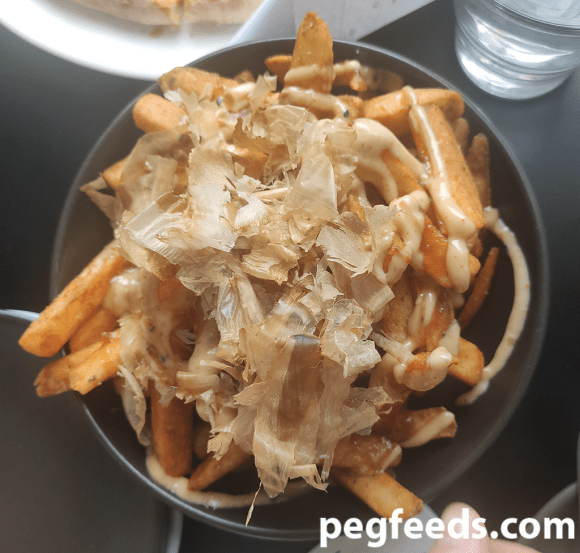
The first thing you should know about these Takoyaki Chips ($9) is that there is absolutely no Tako, nor is there any Yaki. Lacking any actual octopus, these chips are merely inspired by takoyaki – essentially normal potato chips that have been loaded with bonito flakes, mayonnaise, and a sweet okonomoyaki sauce. We ate these chips out of hunger and sadness at our wait. I would not order these again, even if I somehow found myself stranded in Olympic Park in a thunderstorm.
The Smoked Chicken Poke ($22) was the last to come, and the best of the lot. It was served under cling wrap which when removed released a small amount of smoke. The chicken was very tender and along with the rice, edamame and cabbage had a strong smoke flavour. Whilst I wasn’t the biggest fan of the smoke flavour and worry sometimes about the health implications, each component of this poke bowl was otherwise delicious.
A microdose of freshly-squeezed sugarcane juice did not make up for the experience.
A large latte, at $4.30, was sharply priced.
VERDICT The smoked chicken bowl was the one good thing that we had at Mint & Aoshiso, and unfortunately in this case I don’t think one good thing makes up for the rest of the visit.
Mint & Aoshisho Shop 2/1 Brushbox St, Sydney Olympic Park NSW 2127 0452 438 807
After a couple of aborted attempts at eating at Nikkei over the past year, my partner and I finally made it over there to try their $88 pp Japanese-Peruvian tasting menu, inspired by the apparently quite significant Japanese diaspora in Peru. This is a restaurant from the group that runs Osaka Trading Co (which I did not love), but is much better.
The first thing I noticed and enjoyed was this sweet wooden communal dining table. It looked expensive, perhaps carved out of a single tree, and potentially a lot of money. I’d love to have one of these tables in my home one day, to entertain no one. The second thing was this nice drinks menu, bound in a very Midori Traveler’s Notebook esque leather covering, complete with a little bit of patina which I hope continues to develop as the restaurant continues to exist.
Our first little nibble were the empanada bites, two of which were allocated to each diner. These small deep fried bites were crispy and crunch, mostly unidentifiable generalised fried stuff (perhaps it is the edamame but reconstituted?) filled with a small amount of surprisingly large-grain choclo (Peruvian) corn and topped with parmesan cheese. The smoked mayonnaise topping and bottoming, which held the bites to their paper base, was well liked by my colleagues around the table.
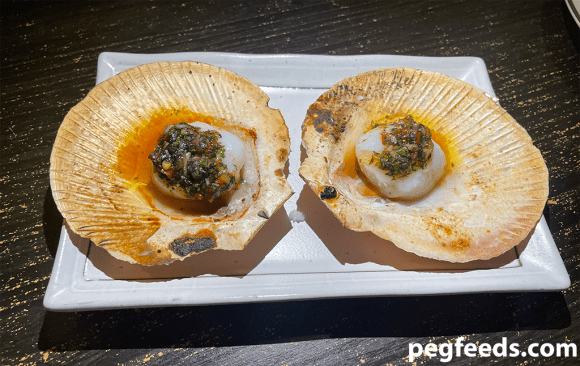
These Hokkaido scallops were quite special, presented in a huacatay (Peruvian black mint) butter, tangy acevichado (ceviche-like) salsa, and tiny balls of arare cracker. The scallops were sweet with a nice torch-born sear to them. The sauce that they were bathed in was both creamy and citrusy, while the lightly puffed arare cracker added additional textural interest, like tiny rice puffs. I would recommend eating this with a spoon to not miss out on all of those beautiful flavours in the sauce.
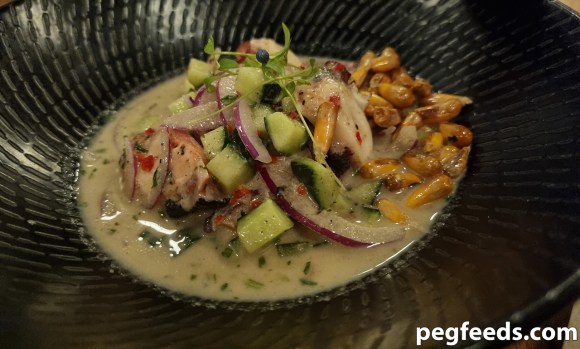
While not all colleagues around the table were impressed by the ceviche de pulpo, I actually thought it was quite good. This was a classic-ish ceviche with a nice tender octopus instead of fish, bathed in a marinade of lime juice and spices, and served with cancha corn, or toated corn kernals. My partner, lover of citrus but hater of certain seafoods, enjoyed this dish, as did I. I thought the flavours were quite bright and fresh, and again enjoyed the variety of textures and flavours offered by the crunchy toasted corn.
The causa sushi is in my opinion an attempt to innovate just a little too much. On offer was a piece of scampi nigiri topped with ikura, and a piece of yellowfin tuna gunkan each. The twist here is that Nikkei has used a mashed-potato base as opposed to rice, an ingredient we were told is common in Peruvian cuisine. While I had a bit of hesitation to eat raw scampi (thinking back to this allergic reaction I had at Moxhe) I told my two anaesthetic colleagues that I was for full resus and went to town on the first scampi I’ve had in a very long time. I think I might have become desensitised.
The seafood was fine, the scampi was sweet and the cubed tuna a little spicy and actually quite tasty. Unfortunately I wish they had just stuck with rice though, as the texture of the causa just didn’t do it for me. Poor rice in sushi can mean the difference between good sushi and bad sushi, and not-rice sushi just makes it all that much worse.
The wagyu maki that followed renewed my sadness that the causa sushi was not just regular sushi. The rice in this was actually quite good. The lightly seared thinly sliced MBS8+ rib eye was well liked by one of my learned colleagues, though to be honest I was less of a fan of the meat itself, but still a fan of the overall package. I enjoyed the mixture of yakinku sauce and anticucho sauce, a sauce we were told was commonly used in Peru for grilled chicken, as well as the crunchiness of the vegetables rolled inside the warm sushi rice.
The chuleta de cerdo was again another dish that was well liked by all the friends around the table except me. I personally thought that the Tokachi-style kurobota pork rib eye was a bit too fatty for me – certainly there was enough lean meat to go around, but perhaps my first piece was just 40% fat and it just set a bad tone for the rest of the dish. I can’t criticise the meat’s tenderness or sweet-savoury flavour, but it is just unfortunate that the texture of the first bite was offputting. What I did enjoy thoroughly in this dish was the delicious sweet potato chips, which were thin, tasty, and went well with just a bit of the meat’s sauce. This dish was served with some charred lemon to squeeze onto the meat, but I didn’t find that it improved my experience. Again – the three other diners on the table universally loved this pork but I just need to tell you how I feel.
I wasn’t crazy about the ensalada de verano. I thought that while they did innovate a little with some spicy yuzu kosho, the leaves were a bit bitter. Whatever. It’s vegetable.
This matcha alfajor dulce de leche ice cream sandwich was actually quite good. A bit difficult to crack without smushing the ice-cream out from under the biscuit, but really quite pleasant tasting. Not too sweet.
THOUGHTS I quite enjoyed the opportunity to eat all of these Peruvian ingredients (particularly interesting corns and sauces) that I’ve never had the chance to eat before. Some of it was quite different, but still tempered in the familiarity of all the Japanese food that my partner and I tend to eat. I quite enjoyed the raw seafood based dishes at the start, moreso than the cooked dishes towards the end, but I do think that overall Nikkei gets a recommendation from me. Many blessings to this crew. (I also enjoyed the unobtrusive but good and knowledgeable service.)
We had a weekday dinner at By Sang, a relatively new Japanese restaurant with some Korean influence sitting on the old Sanpo site in Rosebery, opting for the $70 per person 6 course degustation and the addition of the futomaki. Though not everything lived up to expectations, certain elements of our meal were actually quite good.
We started with the WA Scallop Tataki with salmon roe, and finger lime. The scallops used in this dish were plump and sweet, and matched well with the tangy flavours of the yuzu dressing and finger lime. I wasn’t sure if the greenery was meant to be eaten, and ultimately it remained untouched as we consumed the seafood. I thought this entree was definitely not bad, though my partner wasn’t a huge fan. I think this dish usually comes with some creme fraiche, but ours did not.
The sashimi dish consisted of slices of atlantic salmon, Ora king salmon, red emperor, cuttlefish, kingfish, and tuna (akami). The choice of using both regular salmon and king salmon (also known as chinook salmon) was an interesting one that I would not have made, though I guess perhaps it was a way to introduce novice salmon eaters to the higher quality of king salmon by way of direct comparison. The sashimi course was as fine as most sashimi generally is, though I did feel that the kingfish tasted a bit unusual.
The futomaki (?$35 supplement) of akami, toro, tamago, takuan, scallop, uni, and ikura was an unfortunate weak point. Though enticed by the inclusion of premium elements like uni and toro in this roll, we found that the mish mash of multiple seafoods and flavours per bite-sized piece made it exceedingly difficult to appreciate any individual element. While the overall flavour was good and certainly not bad, we just found ourselves disappointed that this is where we were steered towards when we asked our very enthusiastic waiter about the toro nigiri special. We probably should’ve ordered that instead.
The NSW wagyu tartare with ssamjang, garlic ponzu, wasabi aioli, parsley, and potato crisps was up next. This menu item should’ve been a slam dunk given our recent fondness for steak tartare and my partner’s general love of all things potato, but was again unfortunately a bit of a let down. My main criticisms here would be that the meat itself had a bit of an unfortunate chewiness to the texture, whilst the flavouring was too heavy of sesame oil and salt to my liking. op/;.This really was a Korean fusion take on the classic French dish, and whilst I love my Asian fusion cuisine in general, not all attempts at innovating on a classic are going to be successful. In comparison, the Korean fusion beef tartare at Soul Dining in Surry Hills is a master-stroke, and should be considered first port of call before the one at By Sang.
The NSW sand whiting tempura with papaya salad and white ponzu was a turning point in the meal. While I couldn’t identify any papaya, the moistness of the fish deep fried in a light tempura batter as well as the grated salad and citrus dressing were all very pleasant.
The second consecutive cooked fish dish of the night, the NT Humpty Doo barramundi with grilled wombok and Japanese butter curry was also very good. The fish was grilled to perfection, with a nice crispy skin and moist flesh. The butter curry sauce was particularly good, with a light flavour that tasted a level or two more complex than your average grocery store Japanese curry.
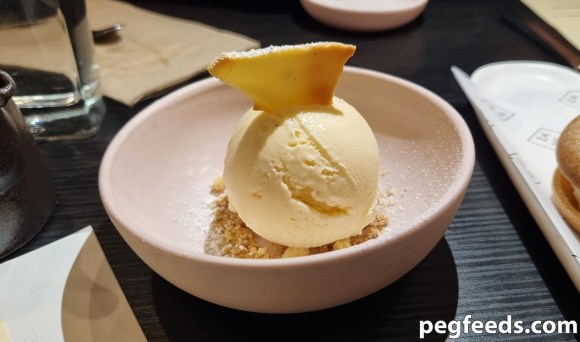
Our first choice of dessert was the Hitachinobeer ice-cream, which came impaled by a bit of crispy biscuit and resting on a bed of crumbs. The ice cream was really special, with a pleasant sweetness intermingled with a distinct but unoffensive beer taste. Though our waiter told us that they don’t make their ice cream in house, I can’t actually find anywhere else online to buy this – and believe me I tried.
Our second choice of dessert was the Peanut Brittle Miso Caramel Sando, which while looking like a giant macaron was more of an ice cream sandwich. Also quite good.
THOUGHTS There were a few hits and a few misses at our first visit to By Sang, though our experience got markedly better once the cooked food and desserts started rolling out. If I could do it all again I would skip the tasting menu, skip the futomaki and tartare, and go straight to the a la carte menu. I also expect that as the restaurant matures some of their kinks will be worked out and menu optimised. I do hope they keep on their current staff though, who were very attentive but not to the point of being overbearing. Whatever they do, I really hope they keep the beer ice cream on the menu.
By Sang 304/1-9 Rothschild Ave, Rosebery NSW 2018 (02) 7251 9251
Located within Forest Lodge’s Tramsheds complex, near the former site of Chase Kojima’s Simulation Senpai, is the Osaka Trading Co, a day and night time Japanese restaurant with an extensive Japanese-focused bar menu which we did not at all partake in.
I’ve not got much experience with Lotus Root Chips ($6), but thought that these ones were pretty good. They crispy at room temperature, and had a good umami flavour to them. They were served with a shichimi chilli spicy mayonnaise dip, which I felt was a bit superfluous as the chips were good on their own. My learned colleagues JZHW and WKS had other opinions, however, having grown up on lotus root chips during their time as Asian youths. They thought that these chips were just middling, and could have been better a bit warmer. I really don’t know. I liked them.
The Tempura Corn with Wasabi Mayonnaise ($14) was good! It’s difficult to go wrong with deep fried corn, and even more difficult skill when wasabi mayo is added into the equation. This wasn’t a planned addition to our meal, but when we saw our waitress walk past us with a dish of this destined for another customer we knew we had to have it as well. Lightly battered and fried, I can recommend this dish.
The Tuna Tartare with pea puree, pea sprouts, wasabi olive oil ($22) was a letdown to say the least. There was nothing particularly wrong about the diced tuna or the accompanying sprouts or pea puree, but also nothing special. The taste and feeling of the dish can be best described as mild and cold. This was a pretty miniscule amount of food for a pretty significant price, and I can’t imagine anyone would be satisfied by it.
The Miso Ramen ($18) was also a disappointment. The bowl featured much corn, some wood ear fungus, and only a single slice of chahsu pork. While additional pork can be ordered for a small $3 fee, there was no mention on the menu of just how little pork would be available in the base bowl. This was a damaging oversight, in my opinion, as many unsuspecting meat fans will leave disappointed. In addition to this, the taste of the broth was a bit dark and bitter rather than a pure miso taste. I suspect this was due to the presence of black garlic oil, however other ramen restaurants like Crows Nests’ Ramen Kaio seem to be able to pull off a black garlic ramen much better.
VERDICT Though Osaka Trading Co’s share plates start strong, there’s much left to be desired by their bigger ticket items of tuna tartare and ramen. I suspect it may be more of a vibe at night with a few drinks, but nonetheless I wouldn’t go back.