The contents of this blog are matters of opinion formed over one more visits. There has been some artistry applied and metaphors and similes should not necessarily be taken literally. All meals are independently paid for - the author has no conflicts of interest to disclose.
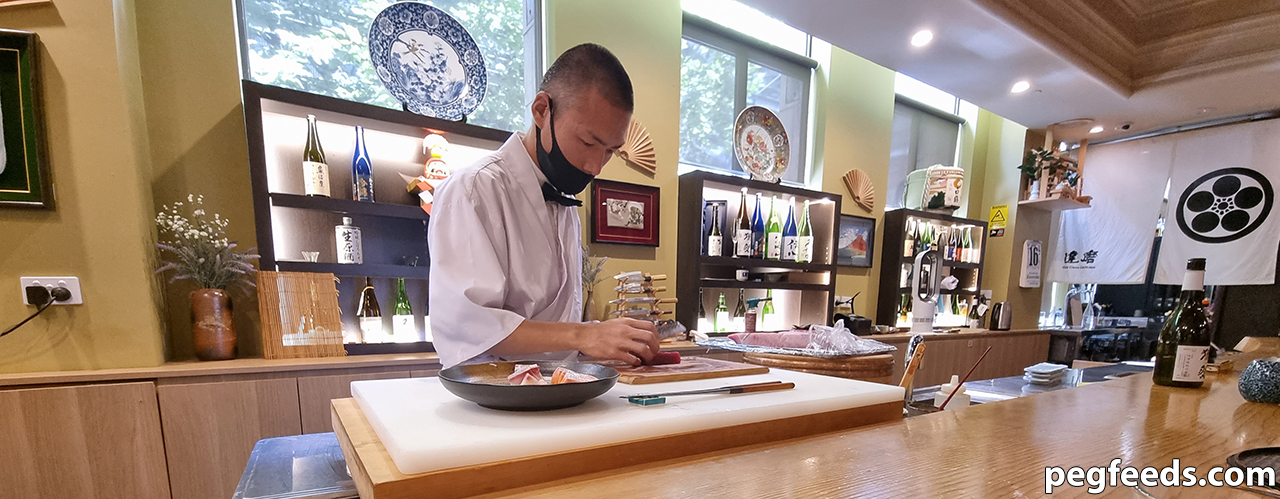
After an aborted attempt at omakase at Gold Class Daruma during the COVID-19 delta outbreak in 2021, my partner and I were finally able to make our way there to experience Chef Yuta Nakamura’s lunch omakase in early 2022.
We started with some kind of beverage. I don’t really know what to tell you. I only had a small sip. I’ve kind of stopped drinking.
Our appetizer was a small, four shaped star plate with tiger prawn, octopus, and spicy cod roe. The cod roe sack was served slightly torched, and though found it to have too strong and salty a flavour for my liking, much preferring such sea eggs mixed with land eggs in a sort of mentai mayo execution. The octopus and prawn were much milder and more enjoyable, with a nice nuttiness exhibited by the prawn and a kind of olive-oil flavour from the tender octopus.
Our next dish was a sashimi dish featuring kingfish, salmon, mildly seared tuna, and seaweed, smoked in front of us on the bench. The smoked flavour was present though ultimately missable if the whole affair didn’t occur before our eyes. The seaweed had an unexpected but appealing apple-like flavour.
Next up was grilled alfonsino collar, though its identity remained a mystery to both us and the diners next to us for some time. It was only when we asked Chef Yuta to repeat himself that he brought out his labelled diagram of the fish and the guy next to me stopped pretending to know what it was. This part of the alfonsino, also known as imperador, was quite oily and mildly fishy. My partner and I were not the biggest fans of this for the fish itself, but we did appreciate the seasoning as well as the yummy pickles that accompanied it.
I’ve never been disappointed by chawanmushi, and this iteration with abalone was no exception, with its silky warming texture and strongly umami flavours.
This is a box of sea creatures about to be placed on rice, divided between four patrons. The fact that Chef Yuta, arguably the most popular chef at Gold Class Daruma, only had the four of us for his lunch seating is quite interesting, as it means that it is difficult for them to achieve the economies of scale that omakase chefs with booked out seatings of six or even eight diners can achieve.
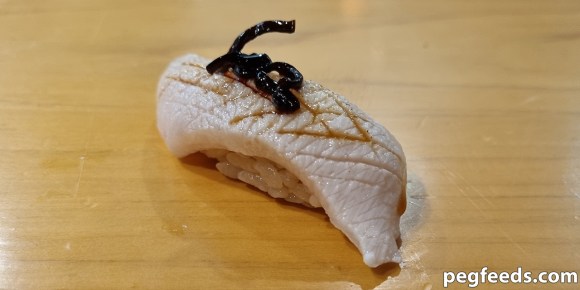
On offer nigiri-wise was a selection of alfonsino, bonito, see eel, paradise prawn, oyster, scallop, kingfish, travelly, cuttlefish, and o-toro. All pieces of nigiri were of a top standard, with fresh fish and perfect warm rice. The cuttlefish did not tickle my partner’s fancy, and she had quite a visceral reaction to its slimy texture, though I personally enjoyed how creamy it was. The bonito was an extremely soft mouthful, and kingfish belly was aburied to further accentuate its oiliness more.
I’m long thought that I might be mildly allergic to raw crustaceans, but steeled myself for my encounter with this raw paradise prawn, which proved to be sweet and non-deadly. The aburi scallop was served with yuzu kosho on top.
The nigiri course was interrupted by a small ikura hand roll.
The nigiri course was capped off with o-otoro topped with caviar, and a great grilled sea eel nigiri that was surprisingly meaty with a non-oily, flaky texture.
The sea urchin and mashed tuna hand roll, with tuna mashed before our eyes was quite good and of an equal standard to other rolls served at other restaurants. I will note that unlike competitors Kuon and Hachijoi Chef Yuta chose to separate the ikura from the uni and toro, serving them as two rolls rather than combined into one.
The miso soup, nearing the end of our meal had a sweet, tare-like flavour.
I didn’t really go to Gold Class Daruma expecting an amazing dessert, and my expectations were therefore fulfilled when we received this mixed plate of yuzu sorbet (good but I feel like it was probably from a tub – happy to be corrected), red bean (which my partner, red-bean hater, liked), matcha cake (quite good actually), and yuzu jelly (which tasted like nothing).
THOUGHTS For $110 pp I feel that Chef Yuta’s omakase at Gold Class Daruma is pretty reasonable. I must admit though that I didn’t love the smoked dish, the mentaiko, or the dessert, and it is highly possible that Gold Class Daruma’s reasonably priced a la carte offerings (ie. $50 for 10 piece nigiri from Chef Yuta) may be even better.
I’d still go again, either for a la carte or for omakase by one of the other chefs.
Gold Class Daruma The Grace Sydney, Level 1/77 York St, Sydney NSW 2000 (02) 9262 1190
Nearing the end of its first year in business, Willoughby’s Hachioji, run by Taiwanese sushi master Benson Pang, is making a move upmarket. With some luck our friends and I were able to secure a booking of the entire 8-seat counter at the original $79pp rather than the more luxurious $130pp offering that has since replaced it.
Our 14-course lunch omakase started with this cod liver entree, a lightly flavoured but densely textured dish.
The four day aged salmon sashimi was served as a fat chunk and with the first appearance of Hachioji’s top-tier wasabi.
This is where the magic happens. Chef Benson Pang advised us that none of the 10 nigiri pieces were to be eaten with soy sauce.
Travelly (New Zealand)4 days aged Hiramasa Kingfish with yuzu koshu
The 4 days aged Hiramasa Kingfish with yuzu koshu was a strong piece, the slight spiciness and tartness of the yuzu koshu adding an additional dimension of flavour to the kingfish.
John Dory with Umeshu JellyOra King Salmon with Caviar (Germany)
The John Dory with umeshu jelly was interesting , the umeshu jelly imparting a sweet but not too sweet plummy flavour which matched well with the light tasting fish. The Ora King Salmon nigiri with caviar was delightfully fatty, with just a little bit of glaze for flavour. I might have to pick up some Ora King salmon to have for myself at home.
Snapper (NZ) with pepperBluefin tuna akami (Tasmania)
Both the snapper with pepper and the bluefin akami were good. The akami was sweet and was free of metallic taste, and it was a pleasure to watch Chef Pang make his invisible flavour cuts.
Chu-toro with citrus peelBlue Mackerel
Hachioji’s bargain basement $79pp price comes into play with the use of chu-toro, a slightly less fatty and cheaper cut than o-toro. That said, the chu-toro nigiri with citrus peel was a good as chu-toro can be, still fatty and flavoured gently with citrus peel (not otherwise specified – my internal medicine friend asked). I liked that the Blue Mackerel added a slightly stronger tasting fish to the mix of flavours.
ScallopAnago (Sea Eel) from Japan
The aburi scallop temaki was good but apart from its superior rice and seaweed the seafood itself was no better than any other scallop I’ve had. The Anago (sea eel) was a large piece, mildly glazed and oily and juicy inside.
I opted for the addition of a chu-toro, uni, ikura hand roll ($25 supplement). This was an expensive and luxurious roll, with a thick and large piece of uni, well flavoured salmon roe, and generous slabs of chu-toro. While one of the best morsels I had at Hachioji, it would be remiss of me to evaluate this without comparing it to Kuon’s very similar hand roll. While sashimi chu-toro has superior texture to the minced o-toro that Kuon uses, I think that ultimately the sheer fattiness of the o-toro in Kuon’s roll wins over the reduced fattiness of Hachioji’s. That said, both are very good, and I would recommend paying for this $25 addition to your meal.
Our sashimi and sushi courses were followed by dobin mushi, a seafood broth made of prawn, pork, chicken, and mushroom. This was a light broth with a strong umami flavour imparted to it by the addition of fragrant mushrooms and seafood, served in an individual teapot for each diner and a small cup with a tiny lemon wedge. This soup was really nice, wholesome, and warming.
I love myself a hojicha ice cream (my favourite being the one from Mapo in Newtown), though this was not as elaborate as some other desserts that are often served at omakase restaurants.
The Hachioji team comped us this delicious mango cake for our colleague’s birthday. Unfortunately the guest of honour couldn’t make it (there were quite a few last minute cancellations and swaps – it was a whole game of musical chairs trying to wrangle 8 cats for our whole-of-restaurant booking), but this meant that we got to pass the cake around and each have some. It was good – try and bring a birthday friend if you can.
OTHER THINGS
Service was pleasant and friendly, and not at all invasive. Unlimited green tea was included in the price of the meal, which is refreshing after being charged $15 a person for bottomless green tea at Kuon.
2 hour street parking is available around the corner on Tullon St. For the more intrepid, there is one hour parking available on Frenchs Road, which is not enough for the meal, though our keen eyed hostess was helpful in keeping an eye out for parking inspectors.
VERDICT
Our experience at Hachioji went to show that you don’t have to be Japanese to provide a top-tier sushi experience. While some of the elements were reflective of our meal’s top value price, I think that Hachioji does hit the sweet spot at $79 per head. Eating at Hachioji a mere fortnight after Kuon I don’t think that while expensive omakase restaurants like Kuon may have more luxurious elements like lobster and o-toro, I’d rather have six meals at a place like Hachioji than two at Kuon.
It takes good planning, a childhood spent spamming clicks into party quests in MapleStory, and a generous helping of luck to secure a spot at Kuon Omakase, one of Sydney’s newest and at $200, most expensive omakase restaurants. With only two seatings of eight per night, it is an experience so exclusive that multiple senior medical colleagues expressed their dismay at not being to secure a visit for themselves in the weeks leading up to our visit. One of these colleagues even offered to pay a 40% premium to buy one of our seats. Essentially it is Japanese Dorsia.
Executive Chef Hideaki Fukada started the night by introducing us to his lobster friend, who would soon be taken into the back room and slaughtered to produce our first dish of the night: Ise Ebi Sashimi (live lobster) with toro and caviar. Premedicated with loratadine and with adrenaline in pocket, I dug into the sweet, fresh flesh of the lobster, the delicious fatty umami of the tuna belly, and the actually pretty-soft saltiness of the osetra caviar. This was, overall, a good dish to start – even if I was extremely nervous about having an allergic reaction with the first bite of a $240 meal.
Second on the menu were Aomori Hotate, sauteed scallops with butter garlic soy sauce from the Aomori region, on the northernmost part of Honshu. These were lightly flavoured, slightly tougher than I expected, and really didn’t do anything special for me. In fact, they got me a bit worried about the meal to come.
The Traditional Chawanmushi, an egg custard with fish cake, chicken, scallop, prawn, and gingko nut was next – a warm bowl of subtly flavoured goodness. The egg custard was soft and silky, and I felt like I could eat bowls and bowls of it on its own. As for the embedded proteins, the prawn was large and sweet, but unfortunately there is nothing much more to say about the chicken, scallop, or fish cake.
The kusakari tsubodai tatsuta age, fried armorhead served with a slice of okra and a slice of lemon, was really also just fine – though it doesn’t look like armorhead is a commonly eaten fish. The subtle layer of batter helped to seal in the fish’s moisture and sweetness, though at the end of the day this dish didn’t feel much more elevated than any other battered and deep fried fish that I’ve had in my life.
The uni tempura wrapped in shisho leaf was a $20 supplement and one of the best morsels of the night. The Hokkaido sea urchin was plump and creamy, with not even a hint of bitterness. The warmth added to the sea urchin through the tempura process helped make an already melty snack creamier than I could have even imagined. A must get add-on.
This giant abalone was flashed before our eyes five minutes before our next course. This is apparently the amount of time it takes to slice, dice, steam, sauce, and plate abalone.
The steamed abalone in Saikyo miso sauce was generally poorly receieved among our party. Though we appreciated the theatre of seeing the entire abalone, the complex, slightly bitter sauce was certainly very divisive. While I didn’t hate the sauce, I also didn’t really feel like this was anything above and beyond what you’d get in a standard Chinese seafood restaurant.
The Wagyu dish, a full blood MB9+ wagyu strip loin with optional foie gras ($20 supplement), was divine. The juicy meltiness of the beef paired perfectly with the rich umami of the foie gras and the semi-sweet berry sauce. Each bite of this was treasured, though I think it would’ve been just as good without the foie gras.
A fresh yuzu sorbet was offered as our meal transitioned into the nigiri zone.
Executive Chef and Owner Hideaki Fukada, caught in a non-photogenic moment, displaying his box of treasures.
The ten-piece nigiri omakase was overall an excellent journey through the Sydney Fish Markets’ best buys of the day. While it makes for a very poor food blog reading and writing experience for me to not know what exactly each piece was, our friendly chefs also did not make a huge effort to tell us. One tiny bone I have to pick is that the chef made a point to tell us that particular bites cost him $200/kg from the supply side. As a group each paying $240 for much less than a kilogram of fish, it felt like these pricings almost cheapend the experience.
Our selection was essentially an assortment of cuttlefish, o-toro, chu-toro, cuttlefish, calamari, prawn, marinated akami, imperator, tamago, and this most fabulous piece of rich and umami fatty tuna neck that I’ve chosen as the highlight photo. Each bite was a delight, but this piece really took the cake as something special to remember.
Back to our regular programming, this lobster miso soup was delicious and warming. Unfortunately no tools were supplied with which to eat the our lobster friend’s meat, and while I can infer from this that it wasn’t meant to be eaten, this didn’t stop us from trying.
The star of the night and Chef Fukada’s specialty is this amazing temaki of uni, toro, and ikura. Essentially my three favourite sea products into one, each bite of this hand roll was bursting with oceanic umami flavours. Absoutely amazing.
A hot cup of matcha green tea signified the end of our main course, and the beginning of dessert.
Our dessert was a matcha white chocolate mousse, topped with boba with a side of sliced strawberry. Small and delicate, like the rest of our meal.
VERDICT Kuon, by virtue of its exclusivity and unparalleled price-tier, is difficult to consider objectively. Most of the food, especially the bits that involved sea urchin or tuna belly, was certainly very good, however there were still some misses, not just for me, but also for the rest of our group. Comparing it to other Sydney fine dining establishments in this top-tier price range, I’d definitely consider Kuon ($240) to shoot above Quay ($290), and probably also Tetsuya’s ($250). Comparing it to other omakase experiences I’ve had in Sydney, however, I’m not sure that I can definitely say that our meal was worth three times that of our also-excellent omakase experience at Yachiyo ($80). That said, it’s probably the uni-toro-ikura hand roll, and the fact that my partner missed out (dutifully doing a locum in Victoria), that means I’ll probably be back at Kuon in due time.
Kuon Omakase Shop 20/2-58 Little Hay St, Sydney NSW 2000 0488 688 252
Yachiyo seems to be a true hidden gem of Japanese dining in Sydney. It’s one of, if not the only place where you can get a full 20 – piece omakase without basically any notice. My partner and I were able to book at around noon for a same-day Friday evening omakase dinner. Be careful though – If you try and book too late in the day you won’t be able to – but you normally will be able to book the following day.
Yachiyo has three grades of omakase – we chose the middle grade, “OMAKASE MIX”, which featured a bit of yakitori and tempura as well as the usual yakitori. Here’s what we got for $80 per person (it was quite impressive.)
1: Toro nigiri (Japan)
The first nigiri offered was a piece of tuna belly (toro) of Japanese origin. It was very oily and fatty, as tuna belly should be. My partner really enjoyed this first piece, but I felt like mine unfortunately had a bit of connective tissue to it which decreased the quality of the fish. Overall quite good, but I didn’t like it as much as course 2.
2: Bluefin tuna nigiri – aged for twelve days (Australia)
The second piece was nigiri with Australian bluefin tuna, aged for twelve days. This morsel may have been my favourite little morsel of the meal. While not imported from a far away land, I found that the fish in this piece had a perfect texture with no distracting components. It was fatty but not overpoweringly fatty, and the aging really enhanced its umami tuna flavours.
3 – Aburi salmon belly nigiri (Salmon Toro)
The third serving of the night was an aburi salmon belly nigiri. The fatty salmon belly with the lightly caramelised surface with rendered fats was delicious. The chef Mitsuhiro Yashio told us that each salmon only had enough belly to produce six pieces of this nigiri. Poor salmons.
4 – Aburi kingfish belly nigiri (Kingfish toro)
The aburi kingfish belly nigiri was the fourth piece of the meal, and the first piece that I didn’t feel was very special. Chef talked it up a bit as another rare piece of fish, but despite the slightly higher fattiness of it I found the taste and texture not too different from the commodity aburi kingfish nigiri that you would get at a normal sushi restaurant (for example Sushi Rio or Sushi Hotaru). Still yummy.
5 – Bluefin tuna temaki (hand roll)
Piece 5 was the bluefin tuna temaki (hand roll). I wasn’t sure if there was some natto inside – I thought that’s what I saw and is pictured on the left side of the photo, but I couldn’t really taste it and my partner doubts me. Keeping in the theme of the delicious bluefin tuna, this hand roll was also one of my favourites. I loved the tender fatty tuna, as well as the really high quality seaweed. Delicious.
6 – Bluefin tuna sashimi with ponzu dressing
Our sixth dish was bluefin tuna sashimi in ponzu dressing. For some reason I didn’t like this as much. I think I was more a fan of their fish with rice, as rice generally can provide a bit of a contrast to fatty fish.
7 – Royal red prawn nigiri
The seventh course was royal red prawn nigiri. Unfortunately I made a mistake, and the chef paid the price. I had advised the restaurant that I was allergic to scampi, but that prawns and other crustaceans were OK. Unfortunately the prawn that they served me was the exact same prawn (royal red) that I had at the debacle at MOXHE. While I don’t know if it was the prawn or another piece of mystery seafood that set off my gastrointestinal tract, I didn’t want to leave it to chance. Had it been literally any other prawn I probably would’ve gone for it. My partner ended up having both of the royal red prawn – she said that the texture was similar to MOXHE’s but the taste wasn’t as sweet and not as good – and the chef prepared me a consolation prize at no additional cost. Thank you.
7A – Salmon sushi
My consolation prize for not being able to really eat the royal red prawn was this piece of salmon sushi. I can’t find any words to describe this form of sushi, but it was basically a piece of fish and some rice sandwiched within a folded piece of seaweed. Almost like a mini, single bite temaki. It was actually quite good, and very thoughtful and nice of the chef to fix what was ultimately my own doing.
Items eight, nine, and ten were assorted yakitori. I will describe them in the order I ate them in.
Item eight, the chicken thigh yakitori, was juicy and flavourful. It was delicious, and exactly how I remember all of the good yakitori that I had in Japan. It is much better than some of the yakitori I’ve had here in Sydney, for example at Lantern by Wagaya.
Item nine, the salmon belly yakitori, was super fatty and delicious. It basically melted in my mouth as soon as I bit into it, and I loved that there was some crispy skin to mix up the texture. My partner didn’t like this that much but she’s wrong – she’s not a big fan of seafood in general (but seems to love sushi!).
Item ten, the skewered pork and ginger meatballs, were less exciting. The chicken and salmon belly yakitori were just so special, but I felt like the meatballs were just meatballs, and perhaps a bit too strongly flavoured for my liking.
11 – cuttlefish nigiri
Food number eleven was a cuttlefish nigiri with shiso-salt. As I usually eat nigiri with fish-to-tongue, I was quite shocked to receive a strong flavour hit as the shiso-salt coated my tongue with saltiness. Evidently that is not the way to go with this particular piece of sushi. Once I got over the intense saltiness of the salt I started to enjoy the rich, creamy cuttlefish texture and flavours. I don’t normally think of cuttlefish as creamy, but a combination of this particular cuttlefish’s intrinsic qualities, the normally chewy texture of cuttlefish ing eneral, as well as the flavour micro-cuts gave it an extremely creamy flavour that actually lasted a long time in my mouth.
12 – hokkaido scallop nigiri with yuzu dressing
I thought that morsel twelve – hokkaido scallop nigiri with yuzu dressing, was a bit of a letdown. While I’m used to raw scallop being sweet I actually thought this nigiri had a bit of a bitter taste to it.
13 – bar cod nigiri
Dish thirteen was bar cod nigiri. This is the first time I have had bar cod, but to be honest it didn’t leave a lasting impression. It tasted very similar to most other white fish out there.
14 – Tempura zucchini with prawn-meat filing
Number fourteen was tempura zucchini with a prawn-meat filling. Chef warned me about the prawn as I wasn’t keen to eat the earlier prawn sashimi, but I thought I would be ok with this prawn and I was right. I wonder if the potential allergen is something that is denatured by cooking. I enjoyed the tempura – it came fresh from the deep fryer, and the distance from the fryer to us seated at the bar was very limited. This was my first time having tempura zucchini, and I enjoyed it. I’m not sure how common zucchini is as a vegetable to tempura. The prawn meat inside was tasty, but not quite prawn – more like cooked surimi type stuff. Not bad.
15- Oyster sushi
Bite fifteen saw the return of the as yet unnamed temaki-but-not-curled, gunkan-but-not-a-boat, now with oyster filling. I enjoyed this oyster – it was not seasoned, unlike the oysters I’ve been having with dressings at Western restaurants, which helped accentuate the mild ocean flavour. My partner, who is not very keen on oysters at all even tried it.
16 -cooked abalone with rice, sandwiched within a folded nori sheet
Nibble number sixteen was cooked abalone with rice, sandwiched within a folded nori sheet. Abalone is quite an upscale seafood, but I was sad not to have it raw (not that I’m sure if it’s even possible). If I’m being honest I couldn’t really taste the taste of the abalone, which must have been subtle. Most of the flavour was from the sauced up rice and the nori.
17 – Ikura gunkan
Mouthful seventeen was finally something I could identify – ikura gunkan. This particular gunkan had absolutely massive bulbous salmon roes, larger than any I’ve had in recent memory. Unfortunately though I found these particular roe to too marinated for my personal taste. They had a strong sweet and salty taste that didn’t really leave much of the fresh roe flavour. My partner also criticised it for not being as creamy as she would have liked.
18 – Black cod sushi
The eighteenth and final fish piece of the meal was a deliciously fatty cooked black cod sushi. It had a flaky, melt in your mouth texture, with strong patagonian toothfish energy. Yum.
19 – Crunchy matcha dessert
Our nineteenth and final morsel was a crunchy matcha dessert, which tasted of white chocolate and rice puffs. A nice, light, but not very showy end to a nice meal.
Overall we had a really good time at Yachiyo. The food was delicious, the price was excellent, and even the table water was filtered. I can highly recommend, and indeed have already recommended Yachiyo to two separate groups of colleagues on the same night that I’ve eaten there. Yum.